For psychologists, therapists and counsellors
Free psychology resources, ready for your next session
Printable CBT and DBT worksheets, each with a referenced guide to what it is for and how to use it, and a worksheet builder for adapting any of them to the person in front of you.
- Free PDF downloads
- No account needed
- A4 and US Letter
- Referenced guides
The library
Free psychology worksheets
Every worksheet is a clean, print-ready page you can hand to a client, plus a long-form guide with worked examples, tips for using it in therapy, and the research behind it.
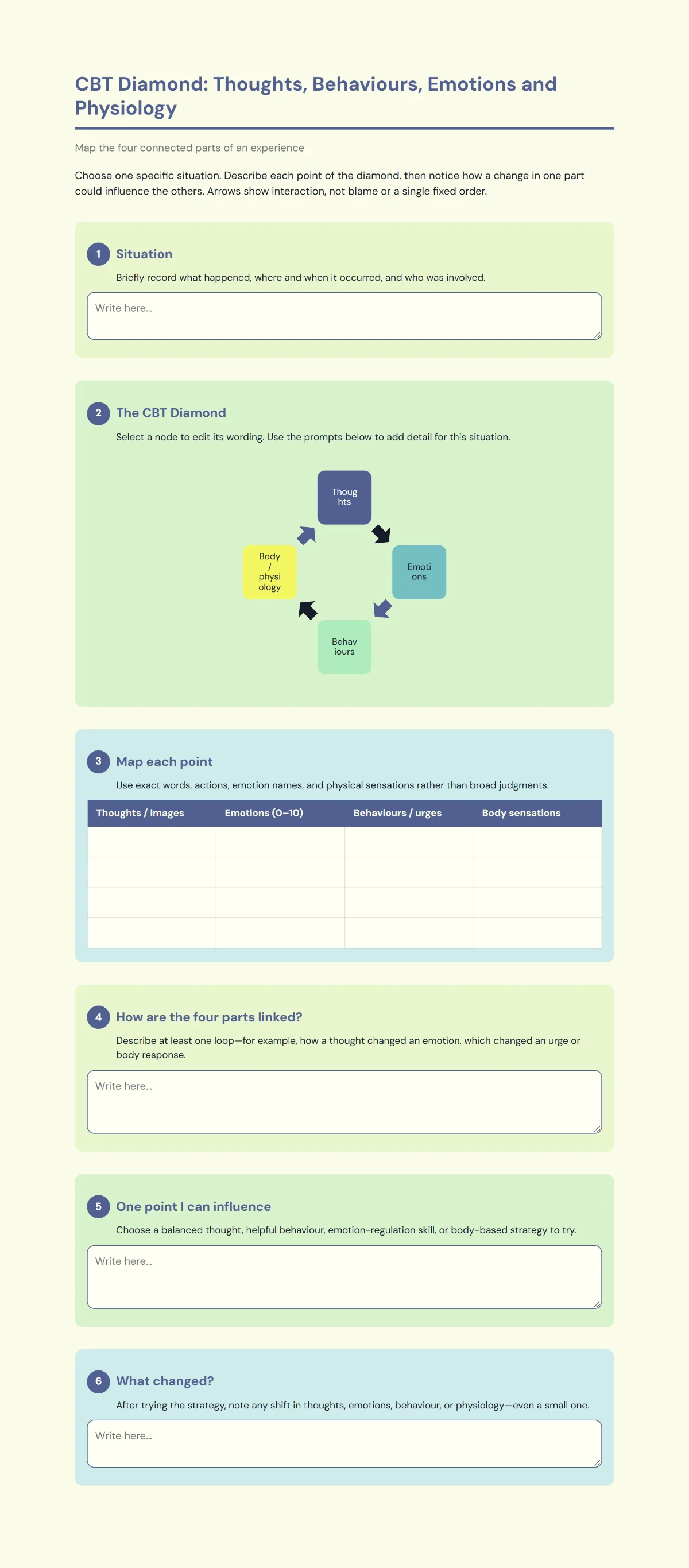 CBT Diamond WorksheetMap one situation across thoughts, feelings, behaviours and body sensations.
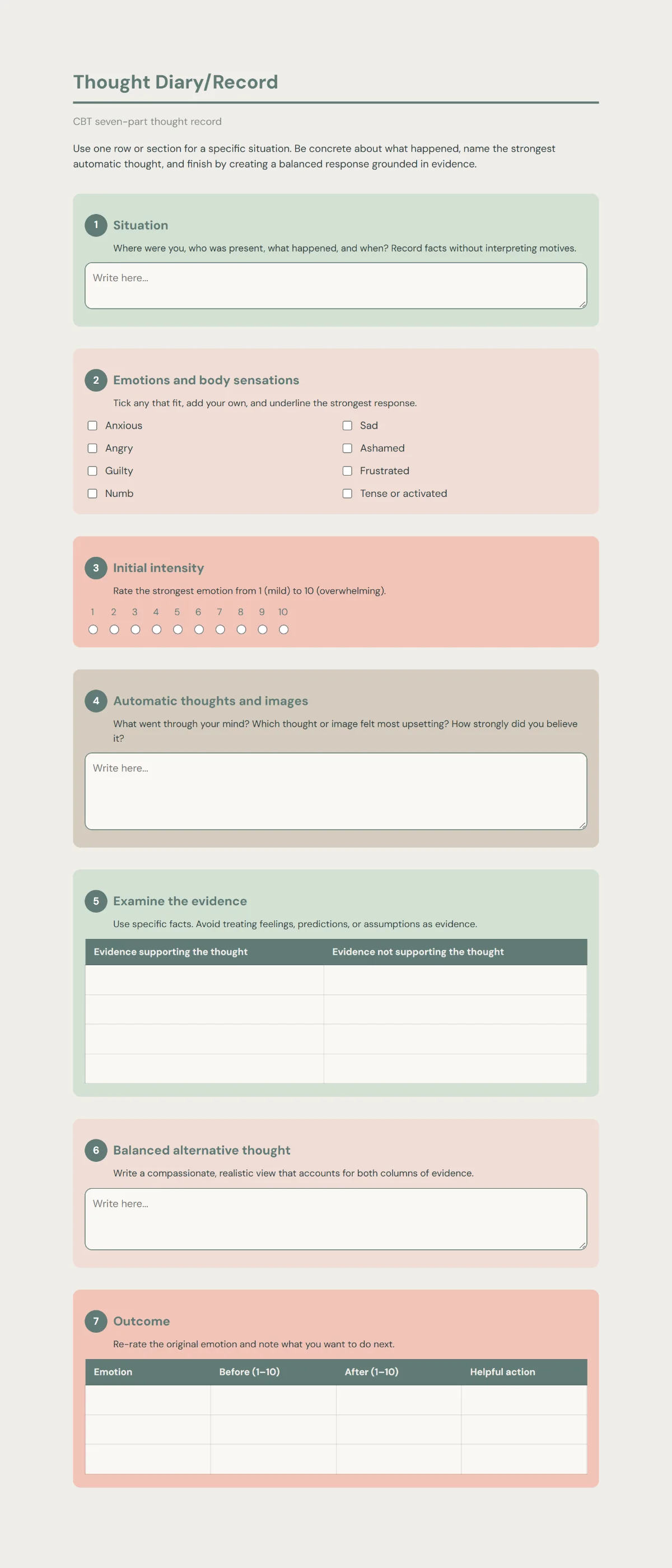 Thought Record WorksheetA seven-part CBT thought diary with a filled-in example.
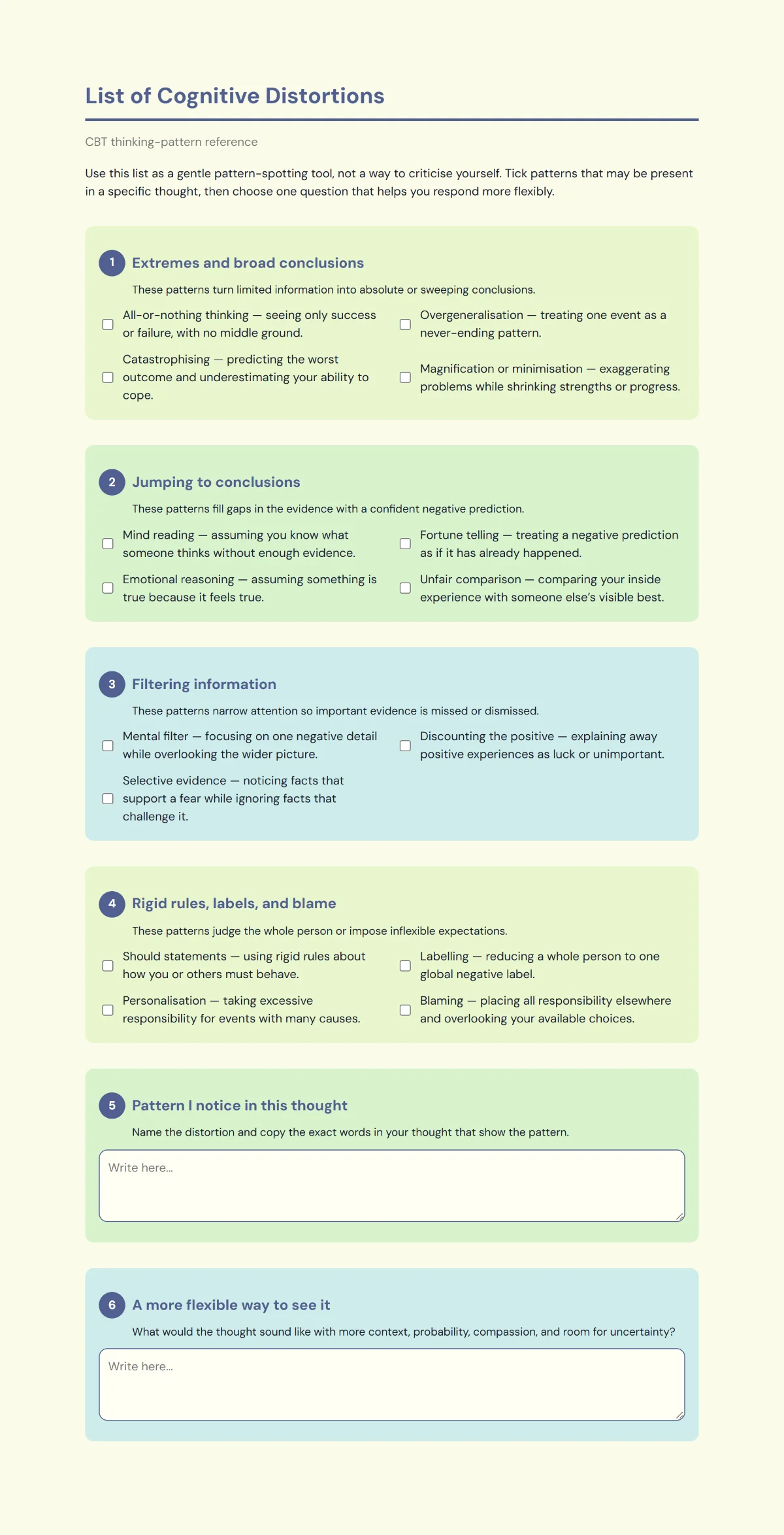 Cognitive Distortions WorksheetA list of 15 thinking traps with everyday examples.
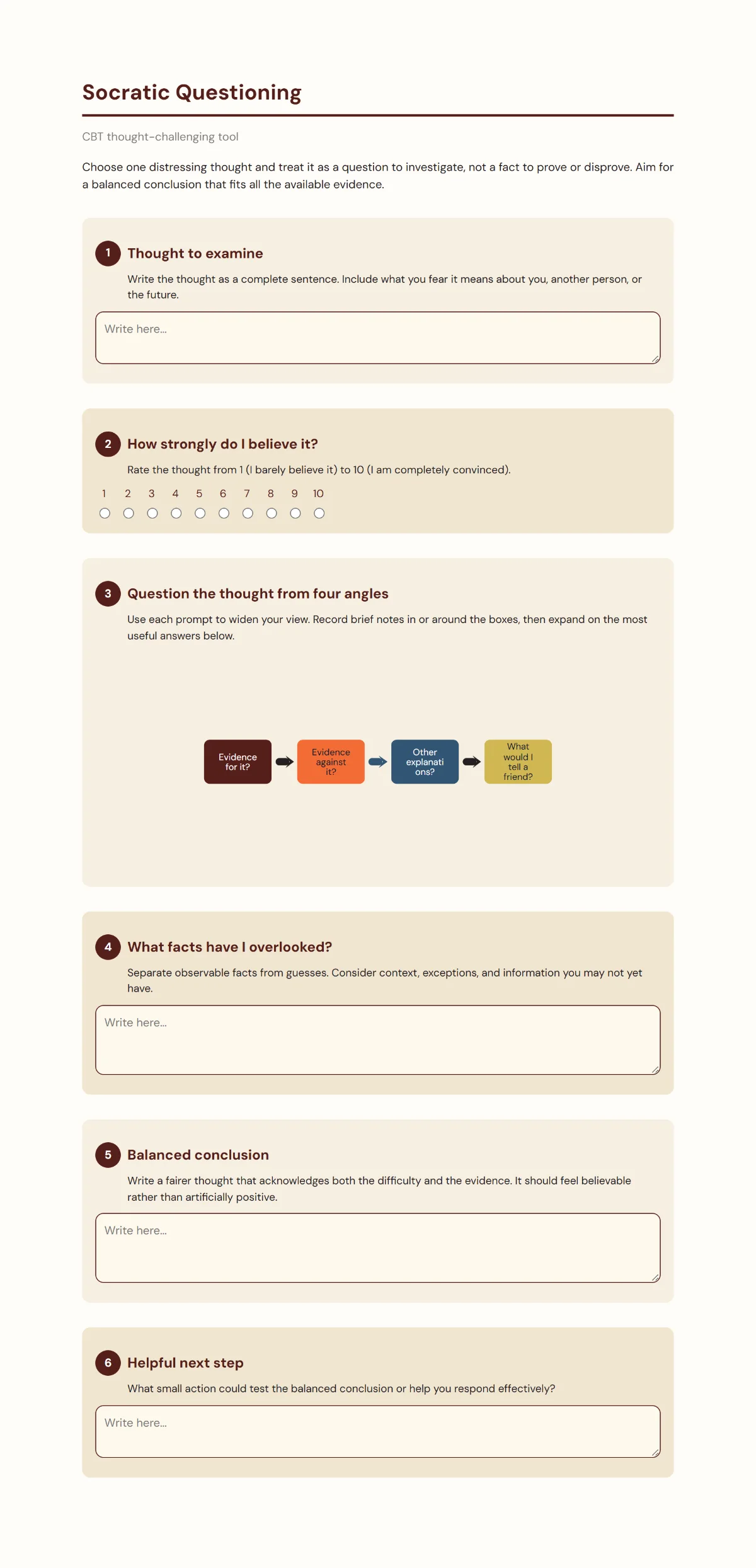 Socratic Questioning WorksheetExamine one distressing thought from four angles.
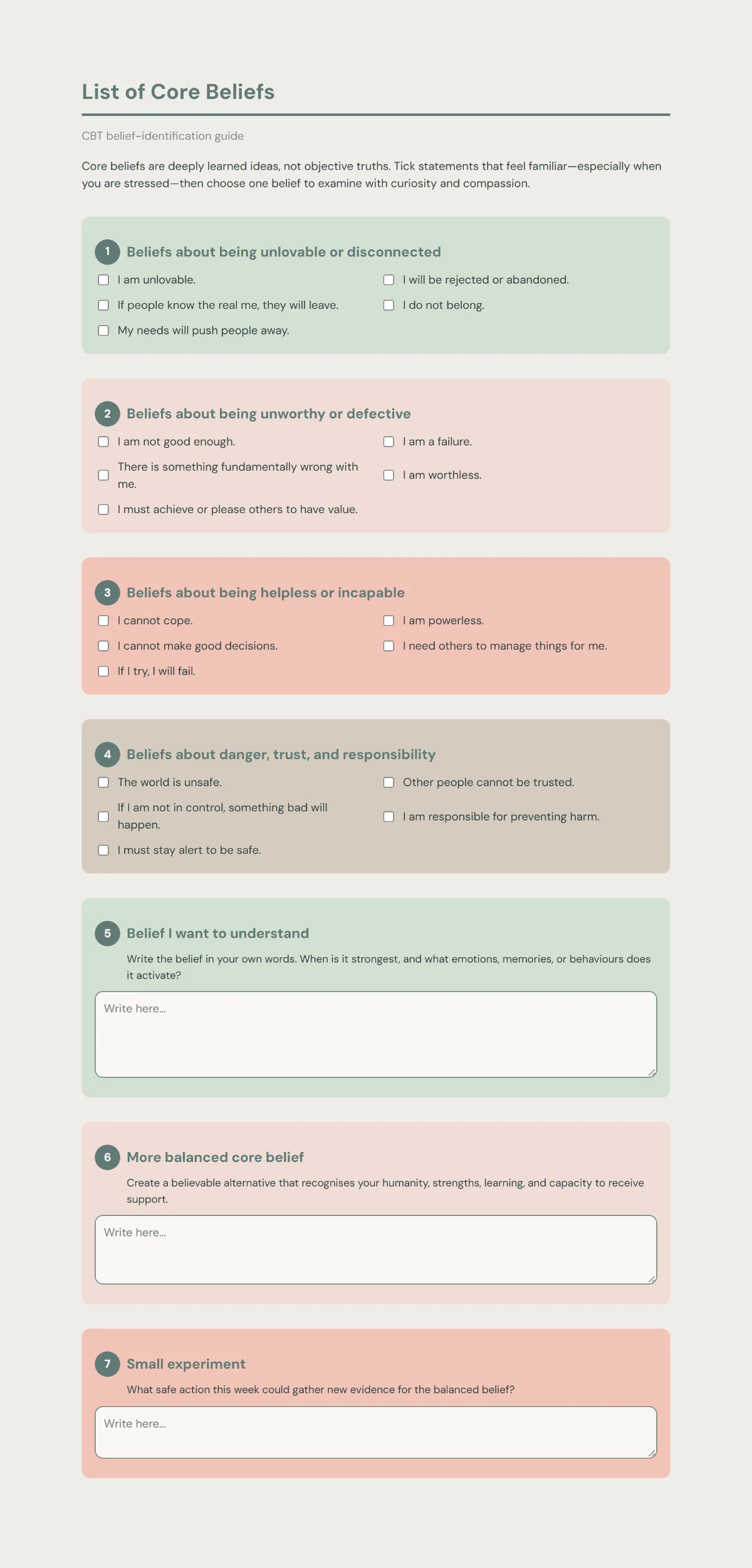 Core Beliefs Worksheet20 common negative core beliefs and a balanced alternative.
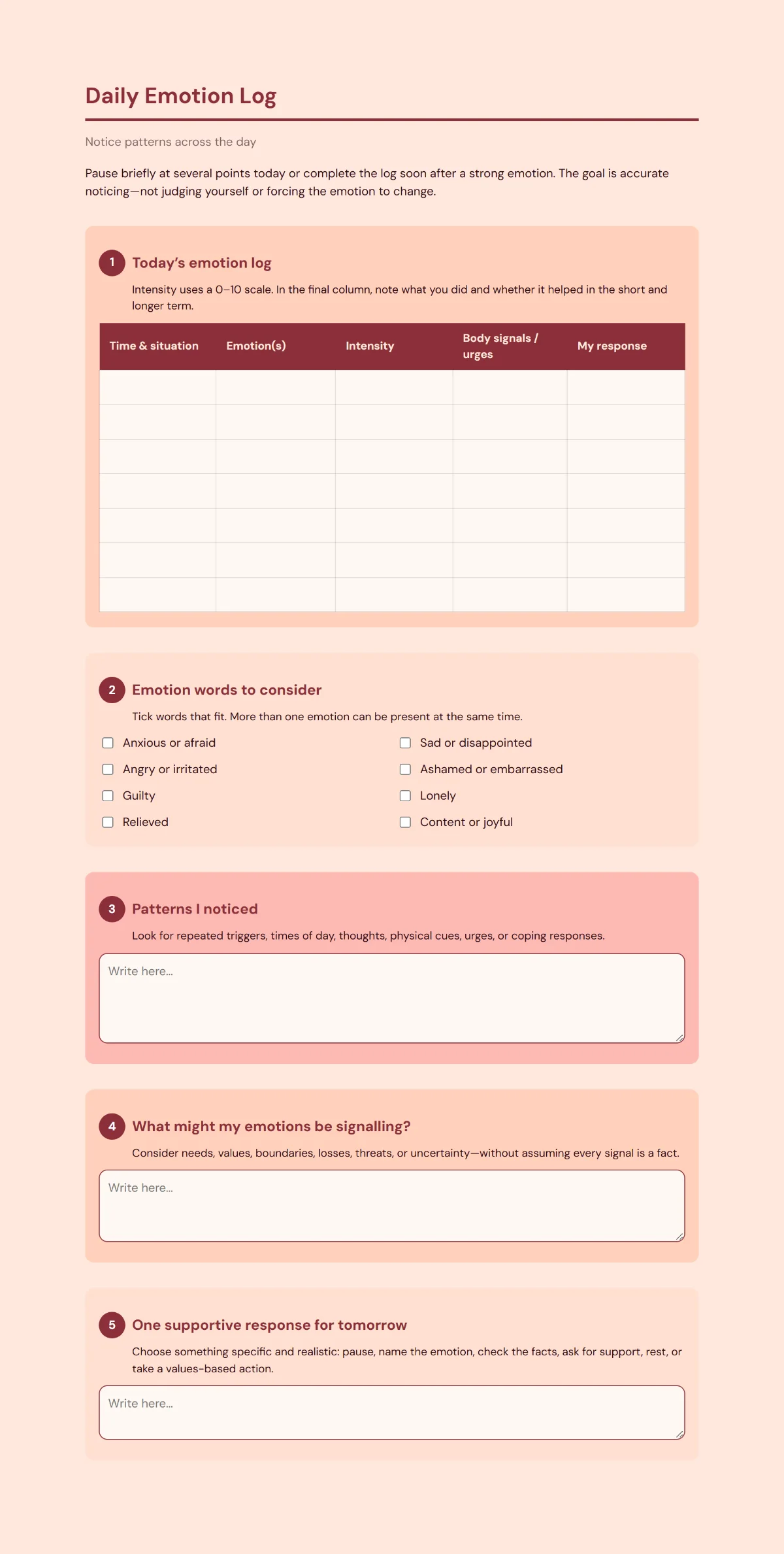 Daily Emotion LogA mood diary for emotions, intensity, urges and responses.
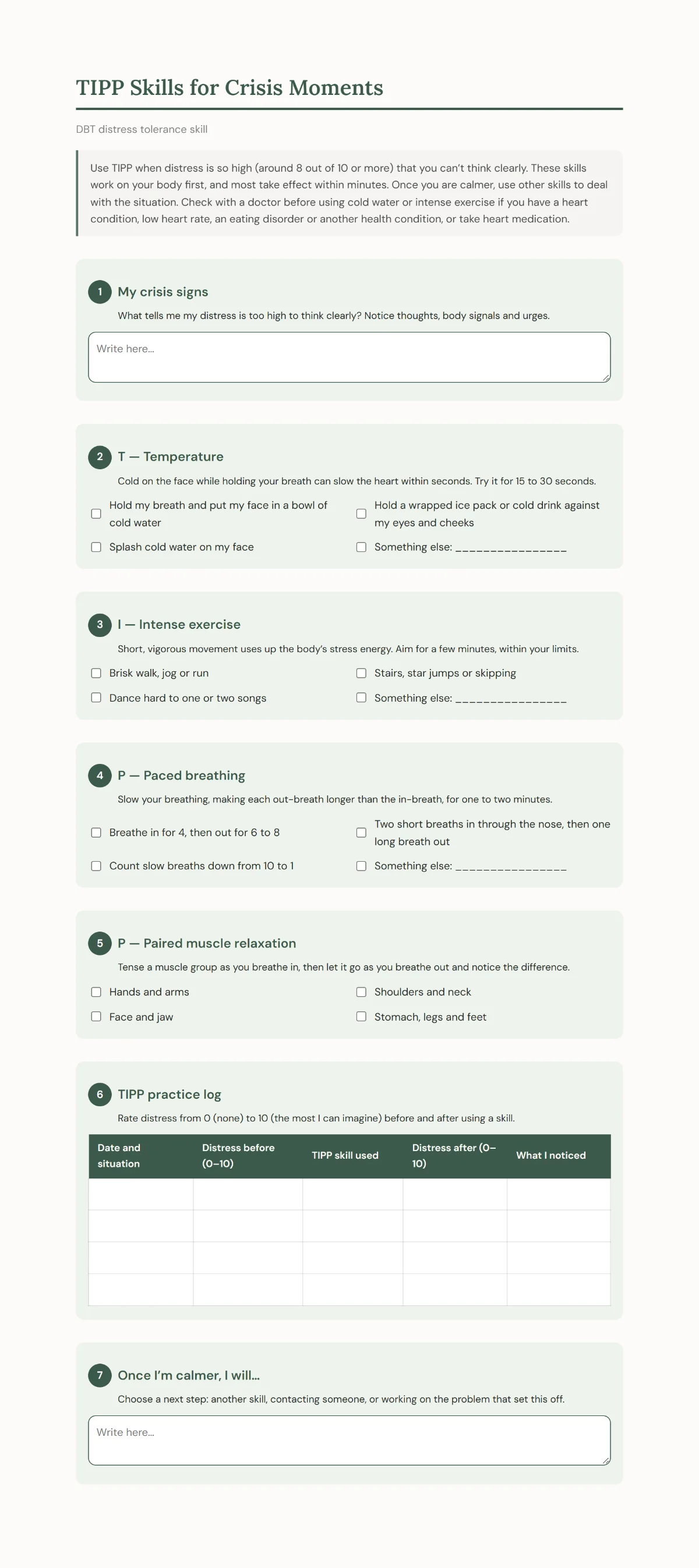 DBT TIPP Skills WorksheetFour fast skills for bringing extreme distress down.
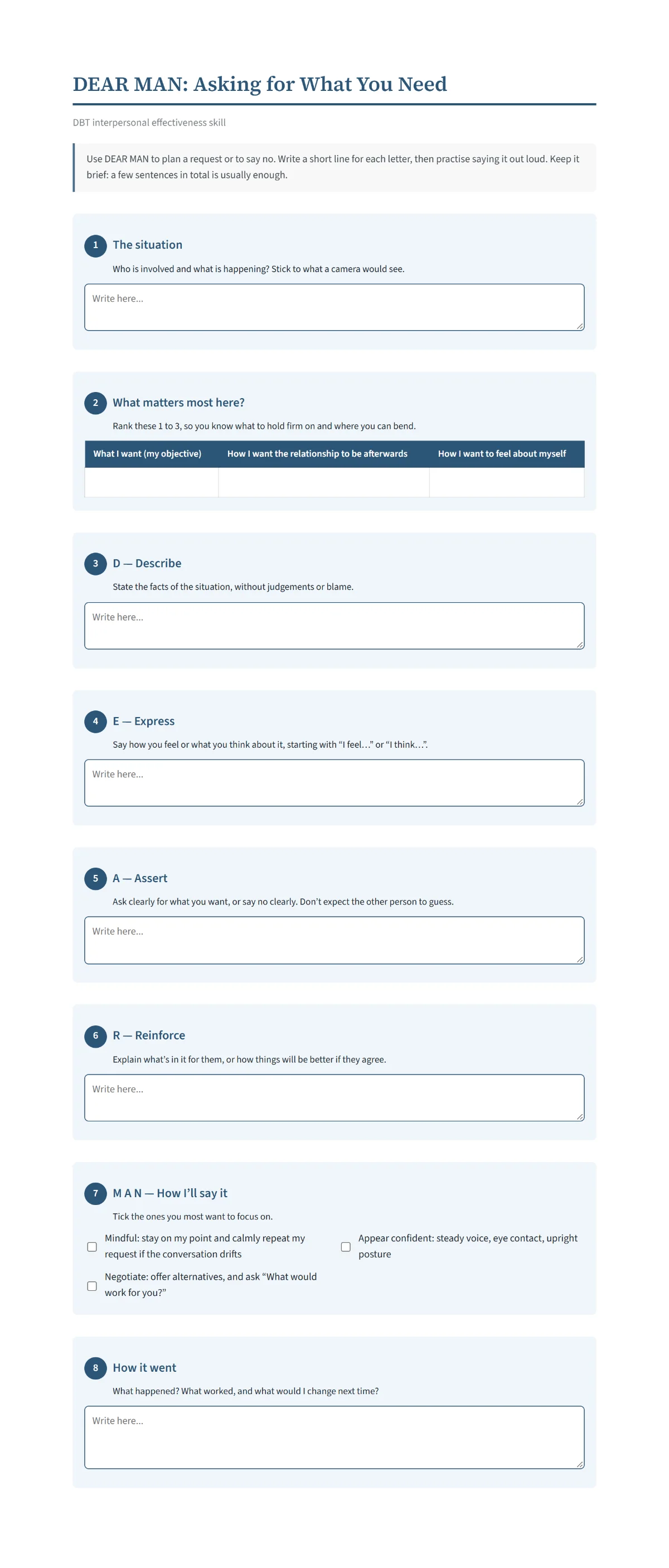 DBT DEAR MAN WorksheetPlan how to ask for what you need, or say no.
Browse by approach
Psychology resources by therapy approach
The library starts with the two most widely used skills-based therapies. Each worksheet follows the structure of the original technique, so it slots into the way you already work.
Cognitive behavioural therapy (CBT)
CBT works on the links between what we think, feel and do. These worksheets help a client slow a difficult moment down, notice the thought driving it, and test that thought against the evidence before settling on a more balanced view.
Dialectical behaviour therapy (DBT)
DBT teaches practical skills for intense emotions and difficult relationships. These worksheets turn individual skills into step-by-step plans a client can practise between sessions and reach for when it counts.
Browse by focus
Resources for what your client is working on
Start from the problem rather than the model. Each group below points to the worksheets that fit it best.
Unhelpful thinking
Catch automatic thoughts, name the thinking trap, and weigh the evidence.
Self-esteem and core beliefs
Understand where a long-held belief came from and build a fairer one.
Emotions and distress
Track emotions over the day and bring overwhelming distress down quickly.
Relationships and assertiveness
Plan a difficult conversation, make a clear request, or say no.
Worksheet builder
Customise any worksheet, or build your own
A ready-made worksheet rarely fits every client. Open any worksheet in the builder to reword the prompts, add or remove sections, and change the look before you print it. Or start from a blank page and build a resource for a specific client, group or programme.
The builder shows the worksheet at true paper size with page breaks marked, so what you see is what prints. You can build and download without an account. A free account saves your worksheets to a library you can come back to.
- Six section types. Text boxes, checklists, tables, rating scales, questionnaires and diagrams.
- Eight colour themes. Quiet print-friendly styles, and bolder ones for handouts and groups.
- A4 or US Letter. Page count and breaks update as you switch.
- Print-ready PDF. Download a clean PDF that matches the preview.
In practice
How clinicians use these resources
Worksheets do different jobs at different points in therapy. The same page can support all of these.
In session
Work through a recent situation together, so the model is concrete and the client sees how it applies to them.
Between sessions
Send a worksheet home as practice, then use what the client brings back to shape the next session.
Psychoeducation
Use the guides to explain a concept in plain language, with examples a client can recognise from their own life.
Groups and programmes
Adapt a worksheet in the builder so every handout in a skills group or course shares one consistent style.
Our approach
How our worksheets are made
Grounded in the research
Each worksheet follows an established technique from CBT or DBT, and its guide explains the idea behind it, what the evidence does and does not show, and when it may not be the right fit.
Every guide lists its research references and the date it was last updated, so you can check the sources yourself.
Written to be used
The worksheets are written in plain language, with worked examples and prompts that make sense to someone filling them in alone at home.
They are laid out to print cleanly on an ordinary printer, with light answer boxes and room to write.
Questions
Frequently asked questions
Are the psychology resources really free?
Yes. Every worksheet can be downloaded as a PDF for free, and you do not need an account to download one or to use the builder. A free account is only needed if you want to save worksheets to your library.
Can I use the worksheets with my clients?
Yes. They are made for psychologists, therapists, counsellors and other mental health professionals to use in their work. As with any resource, review a worksheet before you use it and decide whether it suits the person and the context.
Can I edit a worksheet before I print it?
Yes. Every worksheet page has an option to open it in the builder, where you can change the wording, add or remove sections, switch themes and paper sizes, then download your version as a PDF.
Are the worksheets evidence-based?
Each one is built on an established CBT or DBT technique, and its guide cites the research behind it. The guides also say where the evidence is limited. A worksheet is a tool within therapy, not a treatment on its own.
Can people use these worksheets for self-help?
Many people find the worksheets and guides useful on their own, but they are written with professional support in mind and are not a substitute for assessment or treatment. If you are in crisis, contact your local emergency or crisis service.
What happens to what I type into the builder?
You can build and download as a guest without cloud storage. If you save a worksheet, it is stored in your private account library. Remove anything that could identify a client before you save or export. See the privacy policy for details.
Help shape what comes next
Contact the developers to request new features
Missing a worksheet you use every week, or a feature the builder needs? Leave your email and the developers will get in touch to hear what you would like built.
We read every request, though we cannot promise to build them all. No spam.