What is Socratic questioning?
The method takes its name from the philosopher Socrates, who questioned people until they examined their own assumptions. In psychotherapy, systematic questioning of this kind was described as a way to help clients think through problems for themselves (Overholser, 1993).
In CBT, Socratic questioning is part of guided discovery. Christine Padesky argued that its purpose is not to change a client’s mind but to guide them to discover information they had overlooked, and described four steps: asking informational questions, listening, summarising, and asking synthesising questions that apply what was found to the original belief (Padesky, 1993). Experts still debate exactly how it should be defined and used, which is worth knowing when you read different guides (Kazantzis et al., 2014).
The questions are the same ones therapists use, which means you can learn to ask them yourself. Doing so is one of the skills CBT aims to leave clients with once therapy ends (J. S. Beck, 2020).
List of Socratic questions for CBT
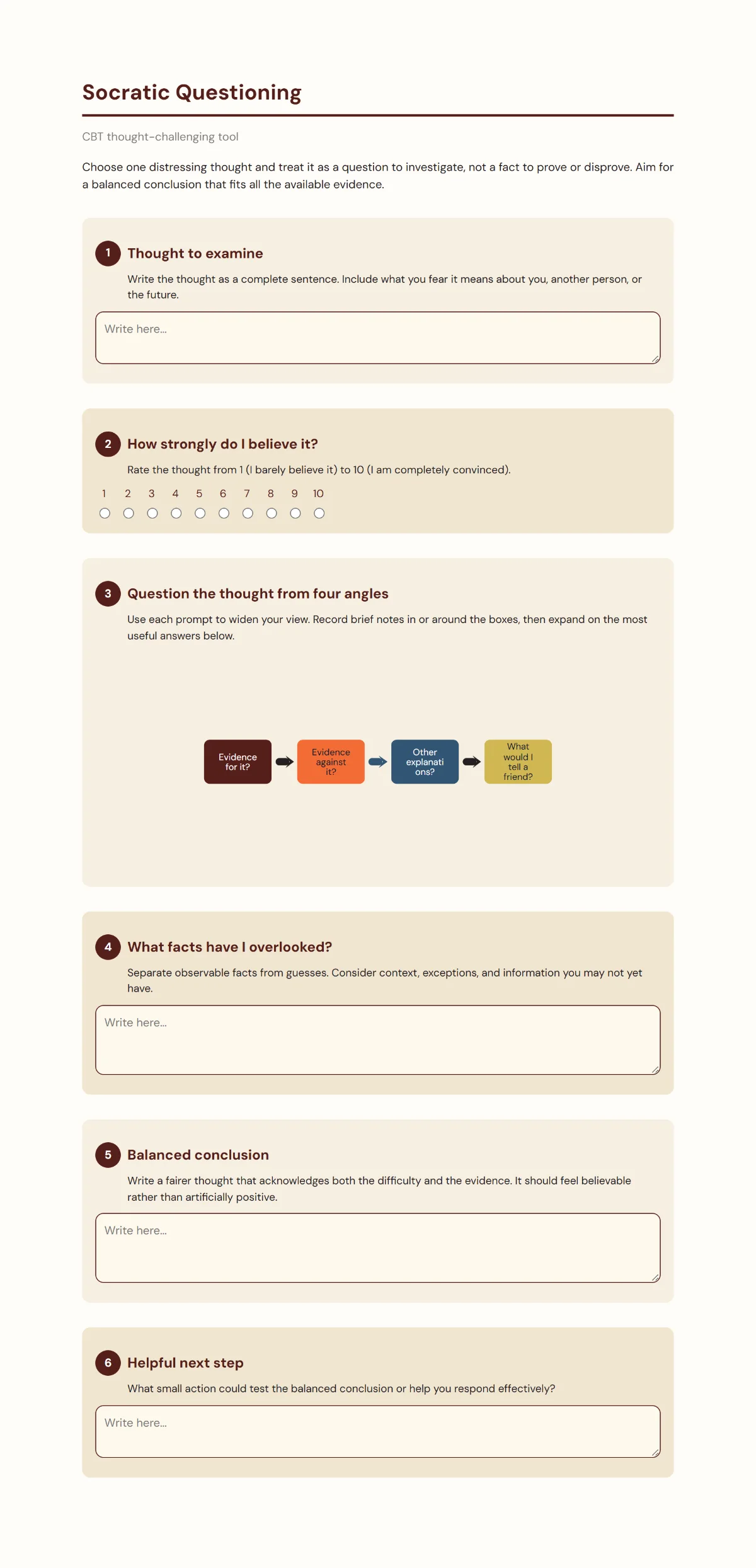
The worksheet asks you to question a thought from four angles. The list below expands each one, and adds questions about consequences and next steps drawn from standard CBT guides (J. S. Beck, 2020; Greenberger & Padesky, 2016). You do not need to ask them all. Choose the two or three that seem most useful for the thought in front of you.
Questions about the evidence
These questions separate facts from interpretations. They are the core of the thought record’s evidence columns (Greenberger & Padesky, 2016).
- What is the evidence that this thought is true?
- What is the evidence that it is not true, or not completely true?
- Am I treating a feeling or a guess as if it were a fact?
- What would someone who disagreed with me point to?
Questions about other explanations
A single event usually has several possible causes. Looking for them loosens the grip of the first explanation that came to mind (J. S. Beck, 2020).
- Is there another way to explain what happened?
- If I didn’t already believe this, what would I conclude from the facts?
- What role did circumstances, other people or chance play?
Questions about perspective
Stepping outside the thought often makes it easier to be fair. The friend question is one of the most widely used in CBT (J. S. Beck, 2020; Greenberger & Padesky, 2016).
- What would I tell a friend who had this thought in the same situation?
- What would someone who cares about me say?
- How will I see this in a week, a month or a year?
- Have I been in a similar situation before, and how did it turn out?
Questions about the worst, best and most likely outcome
Worries often jump to the worst outcome. Asking for the full range of outcomes, and how you would cope, brings the most likely one back into view (J. S. Beck, 2020).
- What is the worst that could realistically happen, and how would I cope?
- What is the best that could happen?
- What is the most likely outcome?
Questions about usefulness and action
Some thoughts are partly true but still unhelpful. These questions shift the focus from whether a thought is true to what you can do (J. S. Beck, 2020).
- What is the effect of believing this thought? What might happen if I changed it?
- What would be a more helpful way to think about this?
- What can I do about the situation, however small?
Socratic questioning examples
These worked examples show the worksheet from start to finish. In both, the balanced conclusion keeps what is true in the original thought, which is what makes it believable (Greenberger & Padesky, 2016).
Example 1: a mistake at work
A worry that one error will define how others see you (J. S. Beck, 2020).
- Thought
- “I sent the report with a wrong figure. Everyone will think I’m incompetent.”
- Belief
- 9/10.
- Evidence for
- The figure was wrong and my manager noticed.
- Evidence against
- I’ve delivered accurate reports for two years. My manager asked for a correction, not an explanation.
- Other explanations
- Mistakes happen when deadlines are tight; others have made similar corrections.
- Friend’s view
- “One mistake doesn’t cancel out two years of good work.”
- Balanced conclusion
- “I made a mistake and fixed it. It’s unlikely to change how people see my work overall.” Belief in original thought now 4/10.
- Next step
- Add a final check to my process before sending reports.
Example 2: a friend who seemed distant
A mind-reading thought, where you assume you know what someone else is thinking without enough evidence (Burns, 1980).
- Thought
- “She was quiet at dinner. She must be tired of me.”
- Belief
- 7/10.
- Evidence for
- She spoke less than usual and left early.
- Evidence against
- She mentioned a hard week at work. She suggested meeting again soon.
- Other explanations
- She was tired or preoccupied with something unrelated to me.
- Friend’s view
- “You don’t know that it was about you. You could just ask how she is.”
- Balanced conclusion
- “She seemed quiet, and there are several likely reasons that have nothing to do with me.” Belief now 3/10.
- Next step
- Send a message asking how her week is going.
How to use the Socratic questioning worksheet
Work on one thought at a time, ideally soon after it upset you. The worksheet follows the same logic as guided discovery in session: gather information, summarise it and then draw a conclusion (Padesky, 1993).
- Write the thought as a complete sentence, including what you fear it means about you, someone else or the future.
- Rate how strongly you believe it from 1 to 10. Belief ratings let you see whether the questions made a difference (Greenberger & Padesky, 2016).
- Work round the four boxes: evidence for, evidence against, other explanations, and what you would tell a friend. Use the question list above if you get stuck (J. S. Beck, 2020).
- In ‘What facts have I overlooked?’, separate what you observed from what you guessed. This is where many people find the missing piece of information (Padesky, 1993).
- Summarise what you found in a balanced conclusion that acknowledges both the difficulty and the evidence. Then re-rate your belief in the original thought.
- Choose a small next step that tests the conclusion or helps you respond. If the thought keeps coming back, a thought record worksheet gives you more room to work through it (Greenberger & Padesky, 2016).
Using Socratic questioning in therapy
Therapists’ use of Socratic questioning has been found to predict session-to-session symptom improvement in cognitive therapy for depression (Braun et al., 2015). A later study of 123 clients found that this effect worked through cognitive change, and that it was strongest for clients who started therapy with fewer CBT skills (Vittorio et al., 2022).
Clients also seem to prefer it. In a video study, lay observers rated a Socratic style as more helpful, more supportive of their autonomy and more likely to get them engaged in therapy tasks than a didactic one (Heiniger et al., 2018). A narrative review nonetheless concluded that the research base is still small, so it is best seen as a well-supported practice rather than a proven active ingredient on its own (Clark & Egan, 2015).
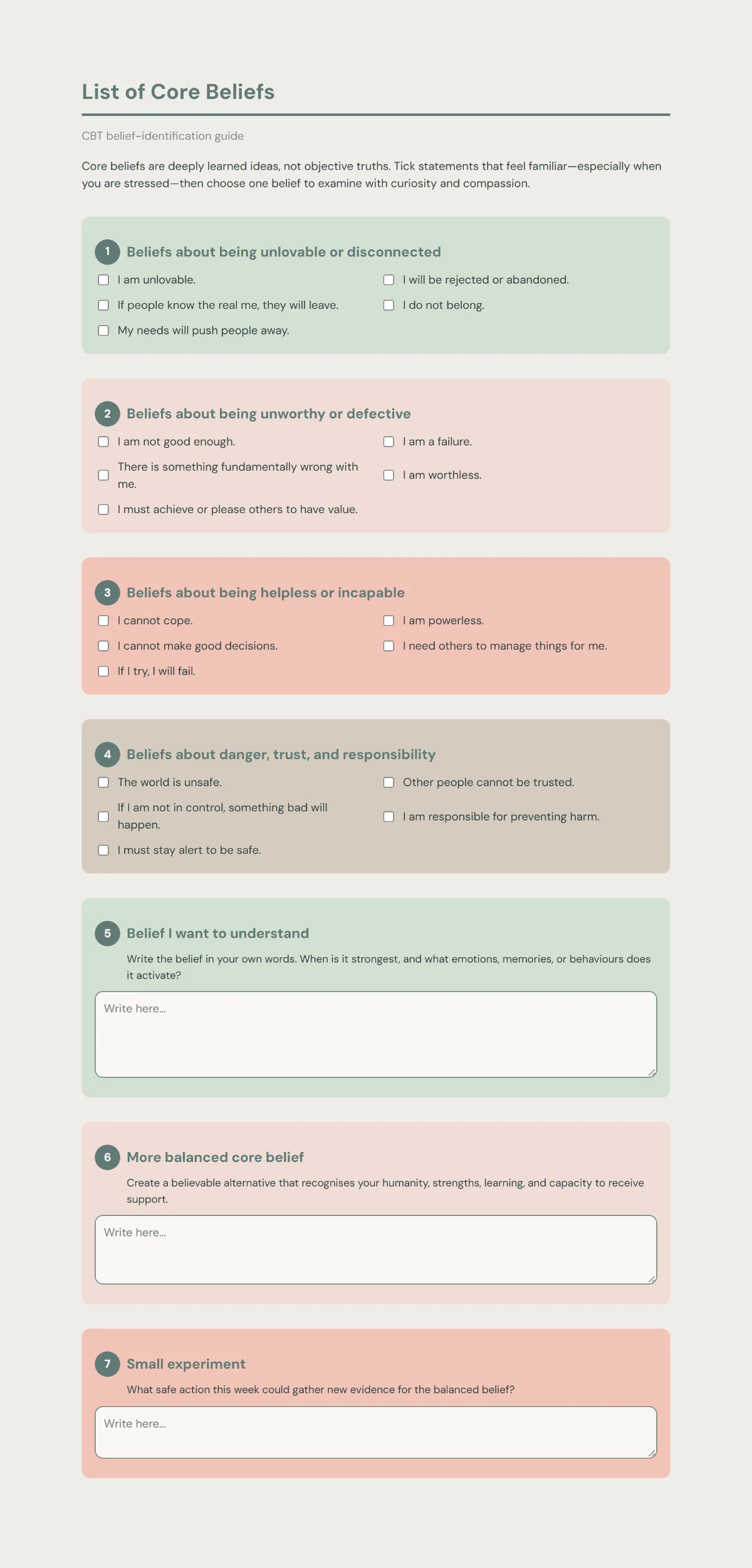
The worksheet gives clients a written version of the dialogue to take home. For clients who keep arriving at the same underlying theme, such as ‘I’m not good enough’, the core beliefs worksheet can be a natural next step (J. S. Beck, 2020).
Does Socratic questioning help?
Socratic questioning sits inside CBT, one of the best-researched psychological treatments. A review of 269 meta-analyses found the strongest support for CBT in anxiety disorders, somatoform disorders, bulimia, anger control problems and general stress (Hofmann et al., 2012), and NICE includes CBT among its recommended treatments for depression in adults (NICE, 2022).
The studies on questioning itself point in the same direction: more Socratic questioning in sessions predicted greater symptom improvement, and cognitive change appeared to carry that effect (Braun et al., 2015; Vittorio et al., 2022). Practising the questions between sessions also counts as homework, which is linked to better outcomes across CBT (Kazantzis et al., 2010).
Common pitfalls
The questions are for discovery, not for proving yourself wrong. If you use them to argue with every feeling, the exercise can start to feel like self-criticism. Padesky warned against questioning aimed at changing someone’s mind rather than exploring with them (Padesky, 1993).
Some thoughts are accurate. When the evidence supports a thought, the useful questions become ‘What can I do?’ and ‘How can I cope?’ (J. S. Beck, 2020). If distressing thoughts are frequent or intense, or include thoughts of harming yourself, speak with a GP, psychologist or other qualified professional.