What are core beliefs?
Beck’s cognitive model describes three levels of thinking. On the surface are automatic thoughts, the quick interpretations that pop up in a situation. Beneath them are intermediate beliefs: rules, attitudes and assumptions such as ‘If I make a mistake, people will reject me’. At the base are core beliefs, which are global and absolute, such as ‘I am unlovable’ (J. S. Beck, 2020; Beck, 1976).
Core beliefs usually develop from early experience and are held so firmly that they feel like facts rather than ideas (J. S. Beck, 2020). Research supports that link: on the Negative Core Beliefs Inventory, stronger negative beliefs about the self and others were associated with reports of negative childhood experiences, attachment styles, anxiety and depression (Osmo et al., 2018).
Schema therapy uses a related idea, early maladaptive schemas, and describes themes such as abandonment, mistrust, defectiveness and failure that closely match the beliefs on this worksheet (Young et al., 2003).
List of core beliefs
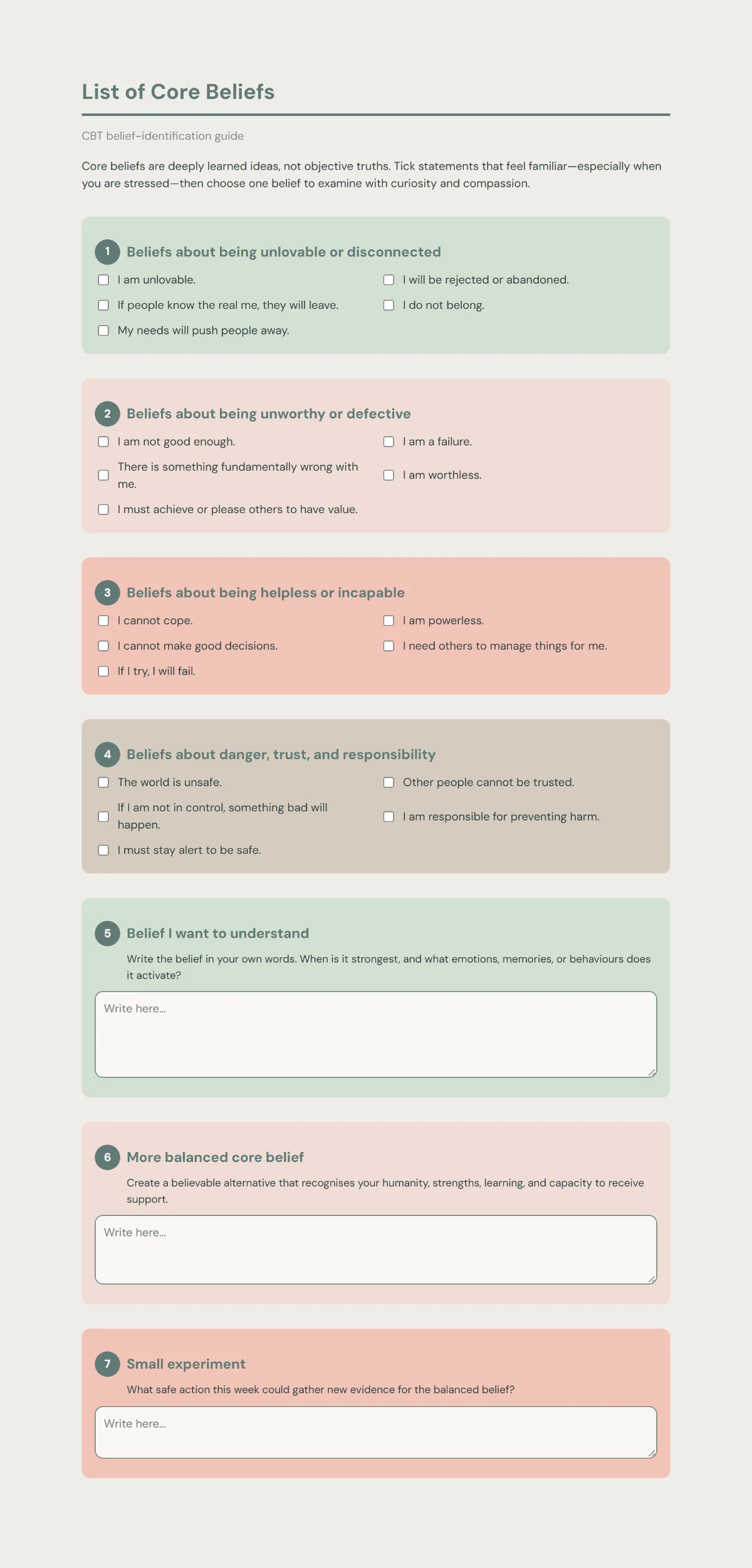
Judith Beck groups negative core beliefs about the self into three broad categories: helpless, unlovable and worthless (J. S. Beck, 2020). A validated questionnaire found a similar structure, separating beliefs about helplessness, vulnerability, unlovability and worthlessness (Osmo et al., 2018). The worksheet uses four themes along the same lines, and adds beliefs about danger, trust and responsibility that are common in anxiety, obsessive-compulsive problems and trauma.
Beliefs about being unlovable or disconnected
These beliefs focus on being unwanted, rejected or left. They are one of Beck’s three main categories (J. S. Beck, 2020) and match the abandonment and social isolation themes described in schema therapy (Young et al., 2003).
- I am unlovable.
- I will be rejected or abandoned.
- If people know the real me, they will leave.
- I do not belong.
- My needs will push people away.
- Often shows up as
- Reading rejection into small signals, hiding your needs, people-pleasing, or avoiding closeness.
Beliefs about being unworthy or defective
These beliefs are about not being good enough or being fundamentally flawed (J. S. Beck, 2020). Schema therapy describes the defectiveness and failure themes, and the belief that approval must be earned (Young et al., 2003).
- I am not good enough.
- I am a failure.
- There is something fundamentally wrong with me.
- I am worthless.
- I must achieve or please others to have value.
- Often shows up as
- Perfectionism, harsh self-criticism, discounting praise, or fear of being ‘found out’.
Beliefs about being helpless or incapable
Helplessness beliefs are about being unable to cope or to influence what happens (J. S. Beck, 2020). They echo research showing that repeated uncontrollable experiences can teach people that their actions do not matter (Abramson et al., 1978).
- I cannot cope.
- I am powerless.
- I cannot make good decisions.
- I need others to manage things for me.
- If I try, I will fail.
- Often shows up as
- Avoiding challenges, relying heavily on others for decisions, or giving up quickly.
Beliefs about danger, trust and responsibility
Beliefs that the world is unsafe or others cannot be trusted are central in cognitive models of trauma, where they help keep a sense of current threat alive (Ehlers & Clark, 2000). An inflated sense of responsibility for preventing harm is a key feature of the cognitive model of obsessive-compulsive problems (Salkovskis, 1985).
- The world is unsafe.
- Other people cannot be trusted.
- If I am not in control, something bad will happen.
- I am responsible for preventing harm.
- I must stay alert to be safe.
- Often shows up as
- Constant vigilance, checking, difficulty relaxing, or reluctance to rely on anyone.
Core beliefs examples
Core beliefs are rarely stated directly. They usually show up through everyday automatic thoughts. The downward arrow technique finds them by taking a thought and repeatedly asking, ‘If that were true, what would it mean about me?’ (J. S. Beck, 2020)
Example 1: from a missed deadline to ‘I am a failure’
A work setback traced down to a belief about worth (J. S. Beck, 2020).
- Automatic thought
- “I missed the deadline. My manager will be disappointed.”
- What would that mean?
- “That I can’t keep up with this job.”
- And that would mean?
- “That I’m not as capable as everyone else.”
- Core belief
- “I am a failure.”
- More balanced belief
- “I’m a capable person who sometimes falls behind, like everyone does.”
Example 2: from an unanswered message to ‘I am unlovable’
A social worry traced down to a belief about being wanted (J. S. Beck, 2020).
- Automatic thought
- “He hasn’t replied. He’s lost interest.”
- What would that mean?
- “That people get bored of me.”
- And that would mean?
- “That there is something about me that pushes people away.”
- Core belief
- “I am unlovable.”
- More balanced belief
- “Some relationships don’t work out, and there are people who care about me.”
How to use the core beliefs worksheet
Approach this worksheet with curiosity rather than judgement. Core beliefs are learned ideas, not objective truths, and noticing one does not mean it is correct (J. S. Beck, 2020; Padesky, 1994).
- Read the list and tick any statements that feel familiar, especially when you are stressed. You may recognise several.
- Choose one belief to work on. In ‘Belief I want to understand’, write it in your own words and note when it is strongest and what emotions, memories or behaviours it sets off (J. S. Beck, 2020).
- If you can’t find a belief that fits, start from a recent upsetting thought and use the downward arrow: keep asking what it would mean about you if the thought were true (J. S. Beck, 2020).
- Write a more balanced core belief. It should be believable, not the extreme opposite. Padesky recommends building a new, more adaptive belief and then collecting evidence for it, rather than only arguing with the old one (Padesky, 1994).
- Keep a record of small everyday experiences that fit the new belief, sometimes called a positive data log (Padesky, 1994).
- Plan a small, safe experiment for the coming week that could gather new evidence. Behavioural experiments are a well-established way to test beliefs, and in one study they changed a belief sooner than a thought record did (Bennett-Levy et al., 2004; McManus et al., 2012).
Working with core beliefs in therapy
Core belief work is usually done after clients have practised identifying and evaluating automatic thoughts, because the same skills are needed and core beliefs can be painful to look at directly (J. S. Beck, 2020). A shared case conceptualisation helps clients see how early experiences, core beliefs, rules and current difficulties fit together (Kuyken et al., 2009).
Useful methods include continuum ratings, which place a belief like ‘I am a failure’ on a 0–100 scale rather than treating it as all-or-nothing, positive data logs and historical tests that review evidence across a whole life (Padesky, 1994). Behavioural experiments often produce the strongest shifts: CBT trainees rated them as more powerful than thought records for changing beliefs (Bennett-Levy, 2003).
The worksheet is editable, so you can remove themes that are not relevant to a client, add beliefs in their own words or change the experiment prompt to fit your treatment plan.
Can core beliefs change?
Core beliefs tend to change more slowly than automatic thoughts, but they can shift (J. S. Beck, 2020; Padesky, 1994). CBT, which targets beliefs at all three levels, has a strong evidence base: a review of 269 meta-analyses found the strongest support in anxiety disorders, somatoform disorders, bulimia, anger control problems and general stress (Hofmann et al., 2012), and NICE includes CBT among its recommended treatments for depression in adults (NICE, 2022).
In an experiment comparing single sessions of two techniques, both thought records and behavioural experiments changed a target belief compared with a control condition. The experiment led to earlier change that generalised further, to beliefs about others as well as the self (McManus et al., 2012).
A note on care
Looking at core beliefs can bring up strong feelings and painful memories, because many of them formed in difficult circumstances (J. S. Beck, 2020; Young et al., 2003). Go gently, and stop if the exercise becomes overwhelming.
Beliefs connected to trauma, abuse or ongoing danger are best explored with a qualified therapist. If you are struggling, or having thoughts of harming yourself, speak with a GP, psychologist or other qualified professional.