What is a thought record?
Cognitive therapy starts from the idea that the way we interpret a situation shapes how we feel and what we do about it (Beck, 1976). Aaron Beck and colleagues gave clients a written form, the Daily Record of Dysfunctional Thoughts, so they could capture those interpretations as they happened and practise answering them (Beck et al., 1979). David Burns later popularised a simpler version, the triple-column technique, for self-help readers (Burns, 1980).
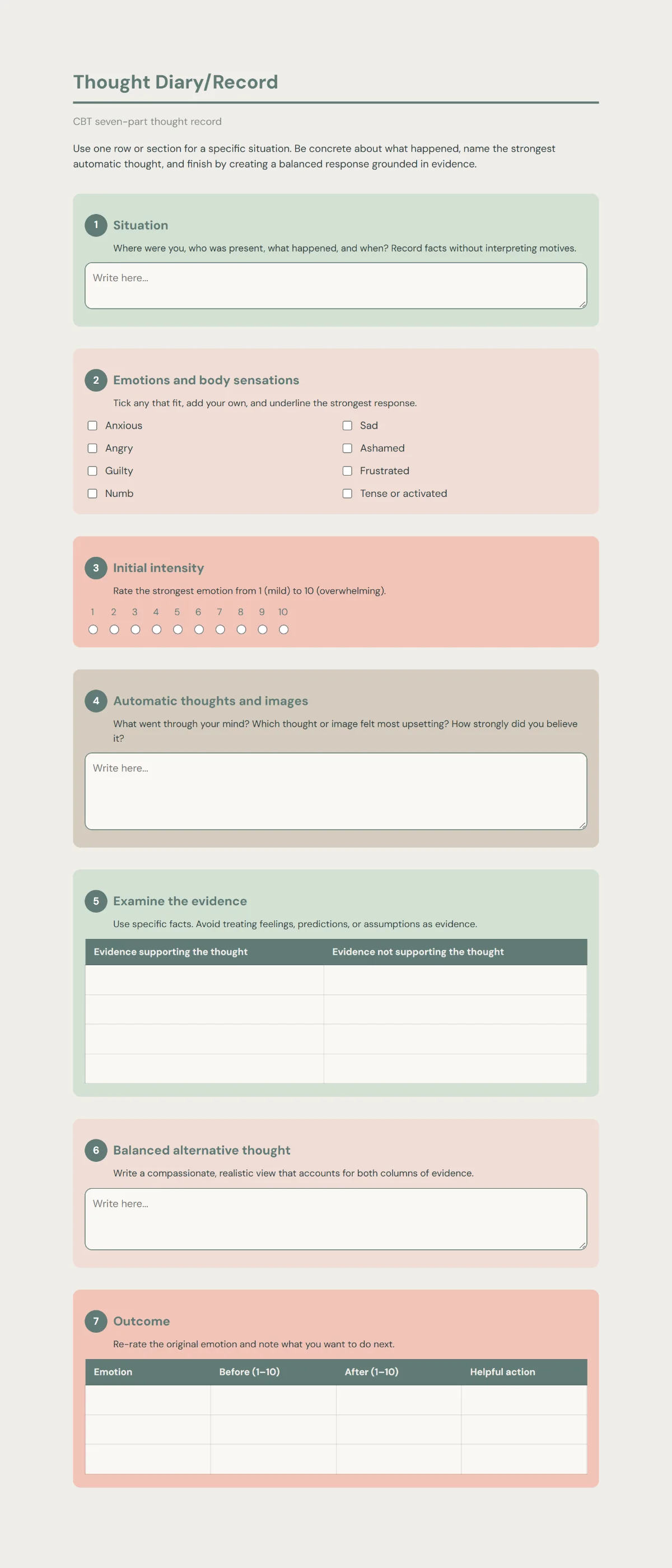
The version most clinicians use today is the seven-column thought record from Mind Over Mood, which adds separate columns for the evidence that supports the thought and the evidence that does not (Greenberger & Padesky, 2016). This worksheet follows that structure. Other names for it include thought diary, thought log and dysfunctional thought record.
A thought record is not about thinking positively. Its aim is a view that fits all of the facts, which may still include real difficulties (J. S. Beck, 2020).
The seven parts of a CBT thought record
Each part of the worksheet has a specific job. Filling them in order moves you from what happened, to how you reacted, to what you made of it, and then to a response grounded in evidence (Greenberger & Padesky, 2016; J. S. Beck, 2020).
1. Situation
Describe where you were, who was there and what happened, as a camera would record it. Keeping the facts separate from your interpretation makes the thought easier to spot later (Greenberger & Padesky, 2016).
- Example
- “Tuesday, 3 pm. My manager walked past my desk without saying hello.”
- Tip
- Leave out words like ‘ignored’ or ‘rude’. They belong in the thoughts section.
2. Emotions and body sensations
Name each emotion in a single word, such as anxious, sad, angry or ashamed, and note what you felt in your body (Greenberger & Padesky, 2016). Putting feelings into words can itself reduce emotional reactivity: in a brain-imaging study, labelling a feeling dampened the amygdala’s response to upsetting images (Lieberman et al., 2007).
- Example
- Anxious, embarrassed. Tight chest, hot face.
- Tip
- If you wrote a sentence (“I felt that she doesn’t like me”), it is probably a thought. Move it to part 4.
3. Initial intensity
Rate the strongest emotion from 1 to 10. A rating gives you a baseline, so you can tell later whether anything shifted, even a little (Greenberger & Padesky, 2016).
- Example
- Anxious 8/10.
- Tip
- There are no right numbers. Consistency across your own records matters more than precision.
4. Automatic thoughts and images
Write down what went through your mind, including any pictures or memories. Automatic thoughts are quick, often unnoticed interpretations that come before the emotion (J. S. Beck, 2020). Pay attention to images too: mental imagery tends to trigger stronger emotion than the same idea put into words (Holmes & Mathews, 2010). Circle the ‘hot thought’, the one most connected to the strongest feeling (Greenberger & Padesky, 2016).
- Example
- “She’s annoyed with my work. I’m going to be let go.” Image of clearing out my desk.
- Tip
- If you get stuck, ask, ‘What was I afraid would happen?’ or ‘What does this say about me?’
5. Examine the evidence
In two columns, list facts that support the hot thought and facts that do not. Feelings, guesses and predictions are not evidence; treating a feeling as proof is a known reasoning trap, and people with anxiety disorders tend to read danger into their own anxious response (Arntz et al., 1995).
- Example
- For: she didn’t say hello; she asked for changes to my report last week. Against: she was on her phone and walking fast; she thanked me for the project on Friday; my last review was positive.
- Tip
- Ask what a neutral observer would count as evidence. If the ‘for’ column is full of feelings, move them back to part 2.
6. Balanced alternative thought
Write a thought that takes both columns into account. It should be believable to you rather than simply positive, and it often starts with ‘Although…’ or ‘It’s true that…, and…’ (Greenberger & Padesky, 2016; J. S. Beck, 2020).
- Example
- “She may have been distracted. She did ask for changes last week, but she also thanked me on Friday, and one missed hello isn’t a sign I’ll lose my job.”
- Tip
- Rate how much you believe the balanced thought. Anything above zero is a start.
7. Outcome
Re-rate the original emotion and note one helpful action. Comparing before and after shows whether the work changed anything, and planning an action turns insight into behaviour, which is where lasting change is often tested (Bennett-Levy et al., 2004).
- Example
- Anxious 8/10 → 4/10. Action: ask her at the team meeting whether the report changes are on track.
- Tip
- If the rating barely moved, look back at part 4. There may be another hot thought you haven’t caught yet.
Thought record example
Here is a complete record for a common social worry, filled in the way the worksheet asks. Notice that the balanced thought keeps the real disappointment rather than denying it (J. S. Beck, 2020).
Example: a cancelled plan
A single event, a friend cancelling, sets off a thought about the whole friendship. Spotting the jump from one event to a general rule is a large part of the work (Burns, 1980).
- Situation
- Saturday morning. My friend texted to cancel lunch an hour before we were due to meet.
- Emotions
- Sad, lonely, a little angry. Heavy feeling in my stomach.
- Intensity
- Sad 7/10.
- Hot thought
- “She doesn’t really want to spend time with me. People always end up drifting away.”
- Evidence for
- She cancelled at short notice. We saw each other less over the winter.
- Evidence against
- She said her child was unwell and suggested next weekend instead. She messaged me twice last week. She came to my birthday dinner.
- Balanced thought
- “It’s disappointing that lunch fell through. She gave a reason and offered another date, which doesn’t fit the idea that she’s pulling away.” Belief: 60%.
- Outcome
- Sad 7/10 → 4/10. Action: reply and book next Saturday.
How to use the thought record worksheet
Complete a record as soon as you can after a strong change in mood, while the details are fresh (J. S. Beck, 2020). It can feel slow at first. Most people get quicker with practice, and the questions eventually become a habit you can use in your head.
- Pick one specific moment, not a whole day or a general worry. A narrow situation gives you clear facts to work with (Greenberger & Padesky, 2016).
- Fill in the situation, emotions and intensity before you start analysing anything.
- List every thought and image, then choose the hot thought. If it is phrased as a question (“What if I fail?”), rewrite it as the statement you fear (“I will fail”) so it can be tested (Greenberger & Padesky, 2016).
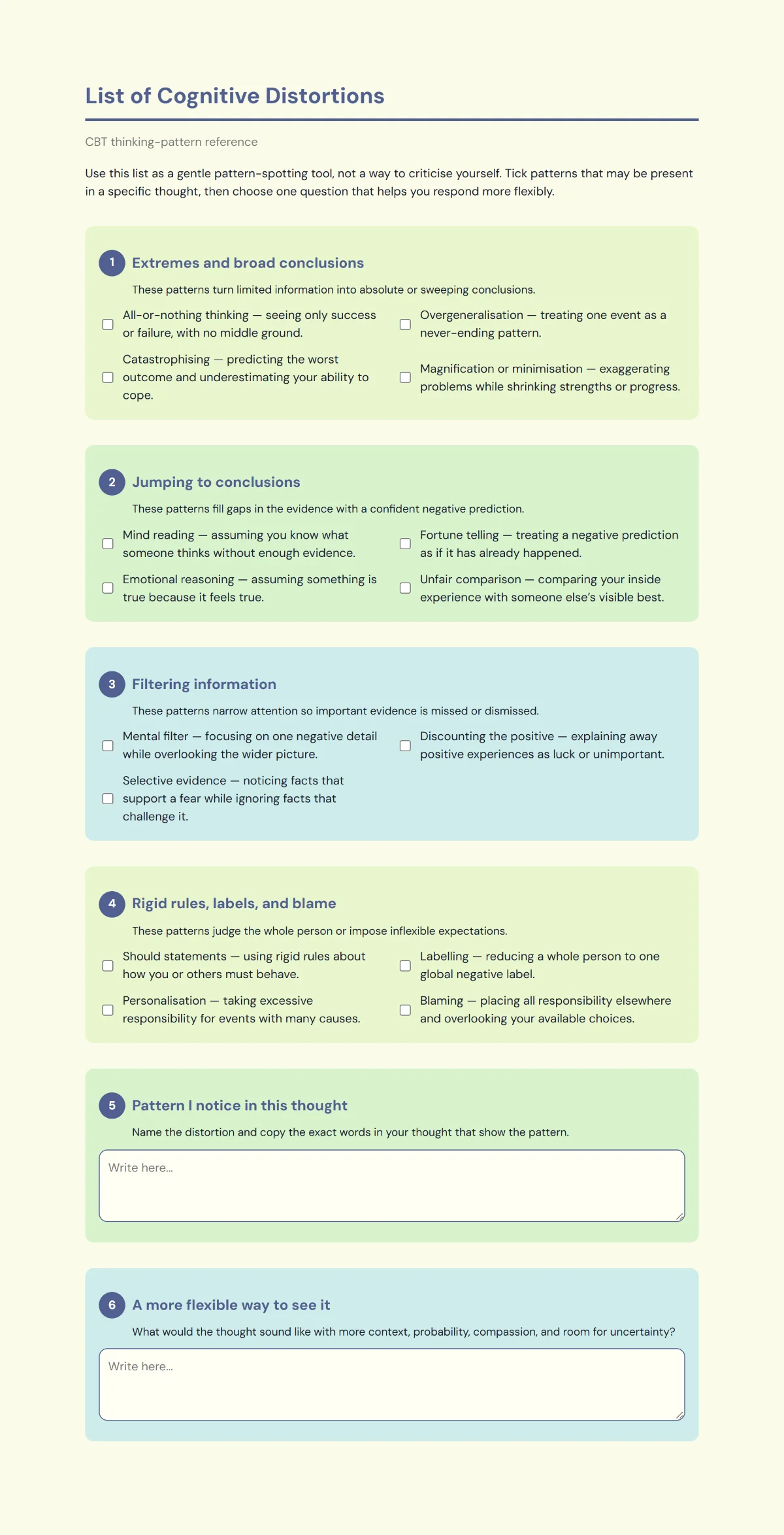
- Work through the evidence columns slowly. If you notice a thinking trap, such as mind reading or catastrophising, the cognitive distortions worksheet can help you name it (Burns, 1980).
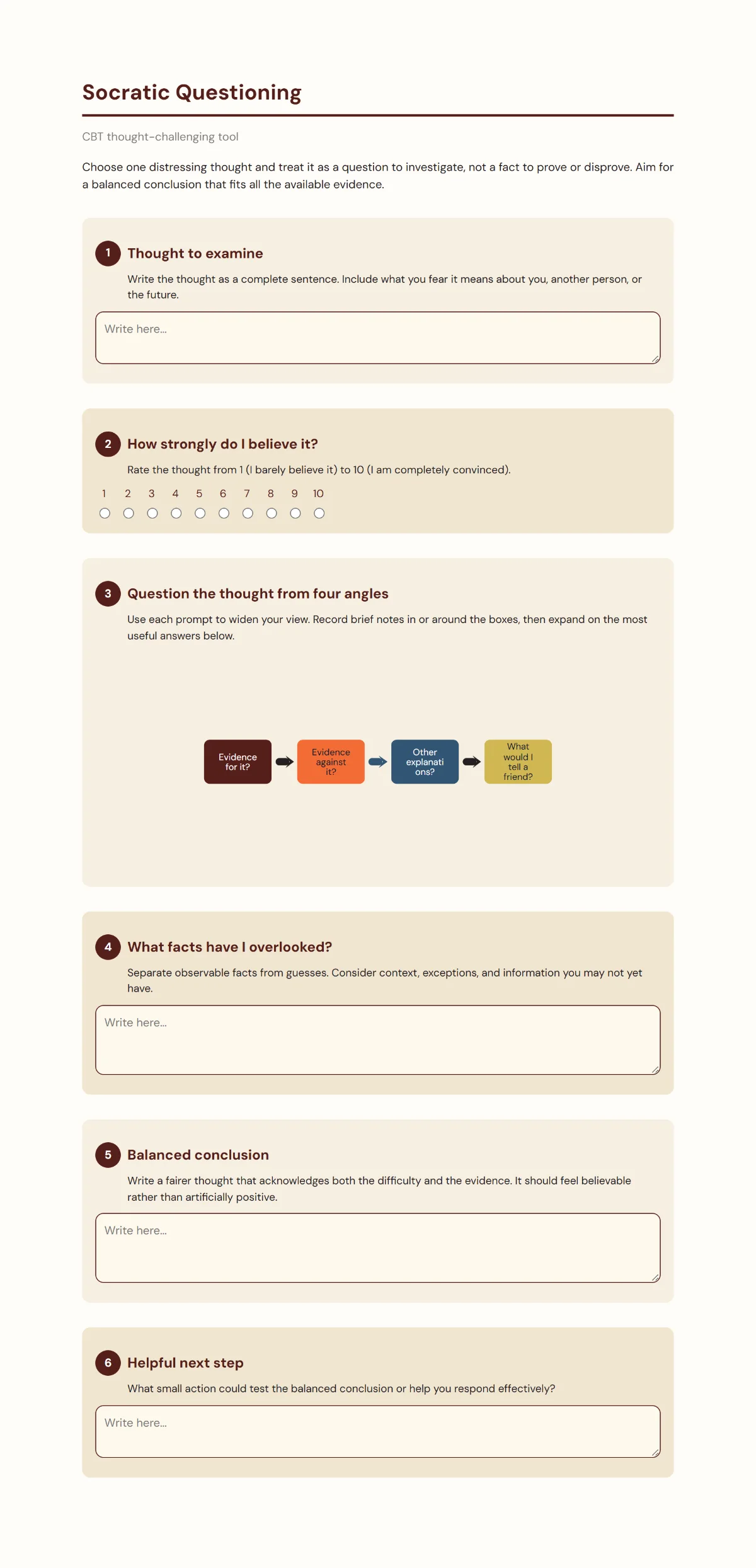
- If you are stuck on the evidence, try the questions in the Socratic questioning worksheet, such as ‘What would I tell a friend who had this thought?’ (J. S. Beck, 2020)
- Write the balanced thought, rate your belief in it and re-rate the original emotion.
- Choose one small action that tests the balanced thought in real life. Direct experience often shifts a belief more than reasoning alone (McManus et al., 2012).
Using thought records in therapy
Thought records are usually introduced after the client understands the link between thoughts and feelings, and are practised together in session before being set as homework (J. S. Beck, 2020). Completing between-session homework is associated with better outcomes in cognitive and behavioural therapy (Kazantzis et al., 2010).
It helps to pair thought records with behavioural experiments. In a study with CBT trainees, experiments were rated as more powerful than thought records for changing beliefs, which the author linked to their engaging a more emotional, experiential level of knowing (Bennett-Levy, 2003). A randomised comparison found both techniques changed beliefs relative to a control condition, with a small advantage for experiments (McManus et al., 2012).
The worksheet is editable, so you can reduce it to three columns for a client who finds the full form overwhelming, or add a row for belief ratings in the balanced thought.
Does using a thought record help?
Thought records are a core technique of CBT, which has a strong evidence base. A review of 269 meta-analyses found the strongest support for CBT in anxiety disorders, somatoform disorders, bulimia, anger control problems and general stress (Hofmann et al., 2012), and cognitive therapy has been found efficacious alone or alongside medication, with a protective effect against relapse (Beck & Dozois, 2011). NICE includes CBT among its recommended treatments for depression in adults (NICE, 2022).
Research on the specific ingredients of CBT suggests that cognitive procedures relieve depressive symptoms and that cognitive change contributes to improvement, though the evidence has methodological limits (Lorenzo-Luaces et al., 2015). Writing things down may add something of its own: studies of expressive writing have found physical and mental health benefits when people write about emotional experiences (Pennebaker, 1997).
When a thought record is not the right tool
Some thoughts turn out to be accurate. When the evidence supports the thought, the next step is problem-solving or coping rather than trying to argue the thought away (J. S. Beck, 2020).
In a crisis, or when emotions are overwhelming, it is usually better to use a calming or grounding skill first and come back to the record later. If upsetting thoughts are frequent or intense, or include thoughts of harming yourself, speak with a GP, psychologist or other qualified professional.