What is an emotion log?
An emotion log, also called a mood diary or feelings journal, is a form of self-monitoring: keeping a written record of your own experiences as they happen. Self-monitoring is used in CBT and related therapies both to understand a problem and as part of treatment, because the act of recording can itself change how people respond (Korotitsch & Nelson-Gray, 1999).
Timing matters. When people describe feelings they are not currently having, they rely more on general beliefs about their emotions than on the experience itself, so reports made later can differ from how they felt at the time (Robinson & Clore, 2002). Recording in daily life, close to the moment, reduces that kind of recall bias (Trull & Ebner-Priemer, 2013).
Emotion logs appear in many approaches. CBT uses mood ratings to link feelings with situations and thoughts (Greenberger & Padesky, 2016), and dialectical behaviour therapy (DBT) teaches observing and describing emotions as a first step in regulating them (Linehan, 2015).
What to record in each column
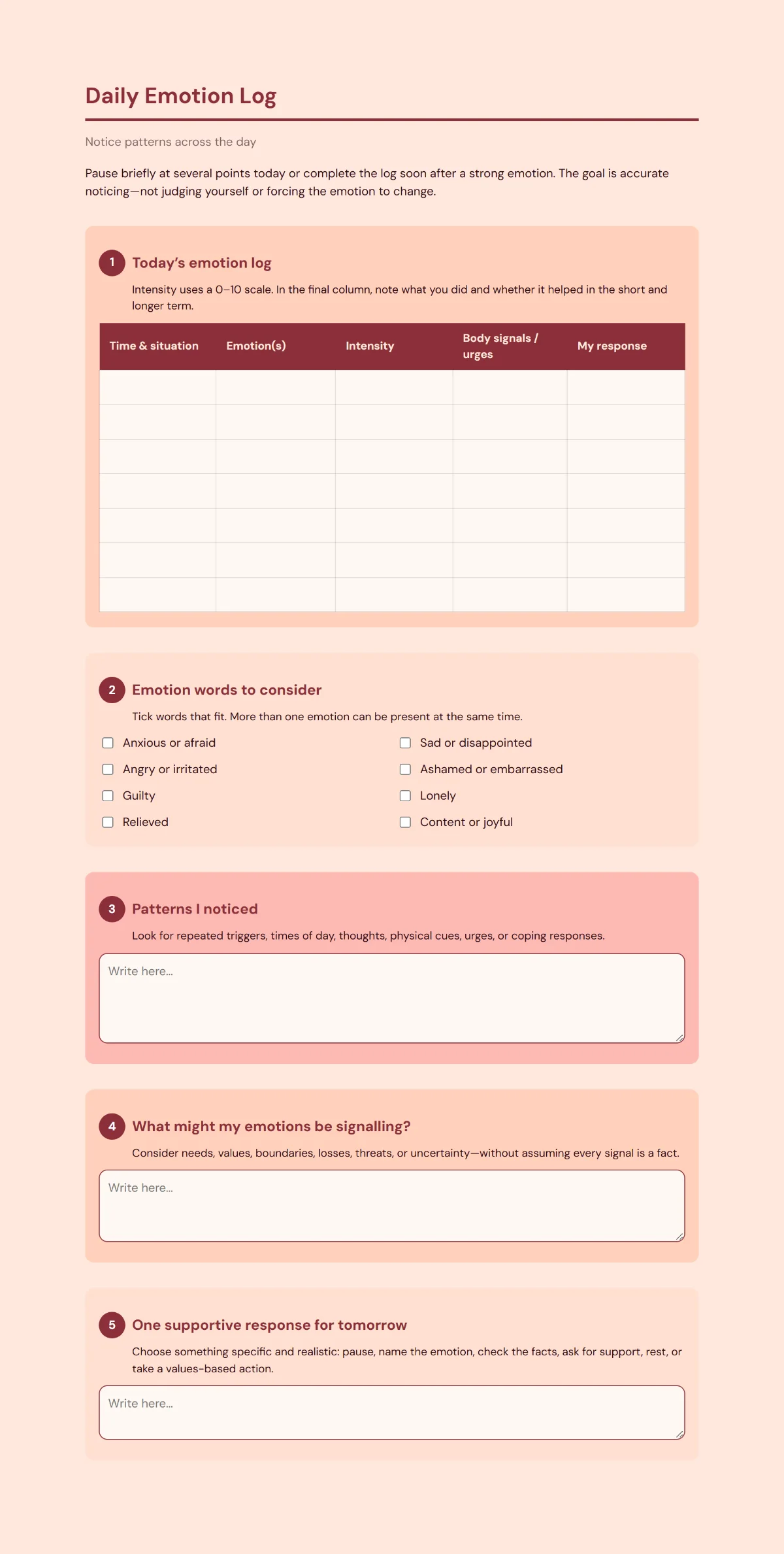
The log has five columns. Together they capture the full sequence of an emotional moment: what set it off, what you felt and noticed, and how you responded (Gross, 1998; Linehan, 2015).
Time and situation
Note when it happened and a brief, factual description of what was going on. Patterns across times of day and types of situation often only become visible after several entries (Greenberger & Padesky, 2016).
- Example
- “8:40 am, running late for work, stuck in traffic.”
- Tip
- Write what a camera would see, not your interpretation of it.
Emotion(s)
Name each emotion in a word or two. More than one can be present at once (Greenberger & Padesky, 2016). Being able to make fine distinctions between emotions, such as ‘irritated’ rather than just ‘bad’, is linked with better emotion regulation (Kashdan et al., 2015), and labelling a feeling can reduce the brain’s emotional reactivity (Lieberman et al., 2007).
- Example
- Frustrated, anxious.
- Tip
- Use the emotion words list on the worksheet if you get stuck.
Intensity
Rate the strongest emotion from 0 to 10. Ratings make it easier to compare entries and to notice when something helped (Greenberger & Padesky, 2016).
- Example
- Frustrated 7/10, anxious 5/10.
- Tip
- Rate how it felt at its peak, not how you feel as you write.
Body signals and urges
Note what you felt physically and what you felt like doing. Emotions come with distinct bodily sensations (Nummenmaa et al., 2014) and action urges, such as the urge to escape when afraid or to lash out when angry (Linehan, 2015).
- Example
- Tight shoulders, clenched jaw. Urge to honk and text my manager an excuse.
- Tip
- Record the urge even if you didn’t act on it. Urges are useful information.
My response
Write what you actually did and whether it helped in the short term and the longer term. Emotion regulation research distinguishes strategies at different points, from changing the situation to changing how you think about it or how you respond (Gross, 1998).
- Example
- Put on a podcast, then messaged my manager once I had parked. Helped a bit now; also helped later.
- Tip
- Something that helps now but causes problems later is worth noting too.
Emotion log example
Here are three entries from one day, followed by the patterns the person noticed. Looking across several entries is where a log becomes most useful (Korotitsch & Nelson-Gray, 1999).
Example: three entries from a Tuesday
Everyday moments, logged soon after they happened (Trull & Ebner-Priemer, 2013).
- 8:40 am
- Stuck in traffic, late. Frustrated 7, anxious 5. Tight shoulders, urge to speed. Put on a podcast, messaged my manager after parking: helped.
- 1:15 pm
- Lunch alone at my desk while colleagues went out. Lonely 6. Heavy chest, urge to scroll my phone. Scrolled for 30 minutes: felt worse.
- 7:30 pm
- Phone call with my sister. Content 7, relieved 5. Relaxed, warm. Stayed on the call longer: helped.
- Patterns noticed
- Loneliness came up around midday and scrolling made it worse. Contact with people lifted my mood.
- Signal
- I miss connection during the workday.
- Tomorrow
- Ask a colleague to get lunch.
How to use the emotion log worksheet
The goal is accurate noticing, not judging yourself or forcing an emotion to change. DBT describes this as observing and describing emotions before deciding what to do with them (Linehan, 2015).
- Decide when you will log. Either pause at a few set points in the day, or fill in an entry soon after any strong emotion. Recording close to the moment gives more accurate information (Robinson & Clore, 2002).
- Fill in the five columns for each entry. Keep it brief; a few words per column is enough.
- Use the emotion words list to name feelings precisely, and tick more than one if they apply (Kashdan et al., 2015).
- At the end of the day, look back over the entries in ‘Patterns I noticed’. Look for repeated triggers, times of day, thoughts, body cues, urges and responses (Greenberger & Padesky, 2016).
- In ‘What might my emotions be signalling?’, consider what each emotion might be telling you about needs, values, losses or threats. Emotions carry information, but a signal is not always a fact, so it is worth checking (Keltner & Gross, 1999; Linehan, 2015).
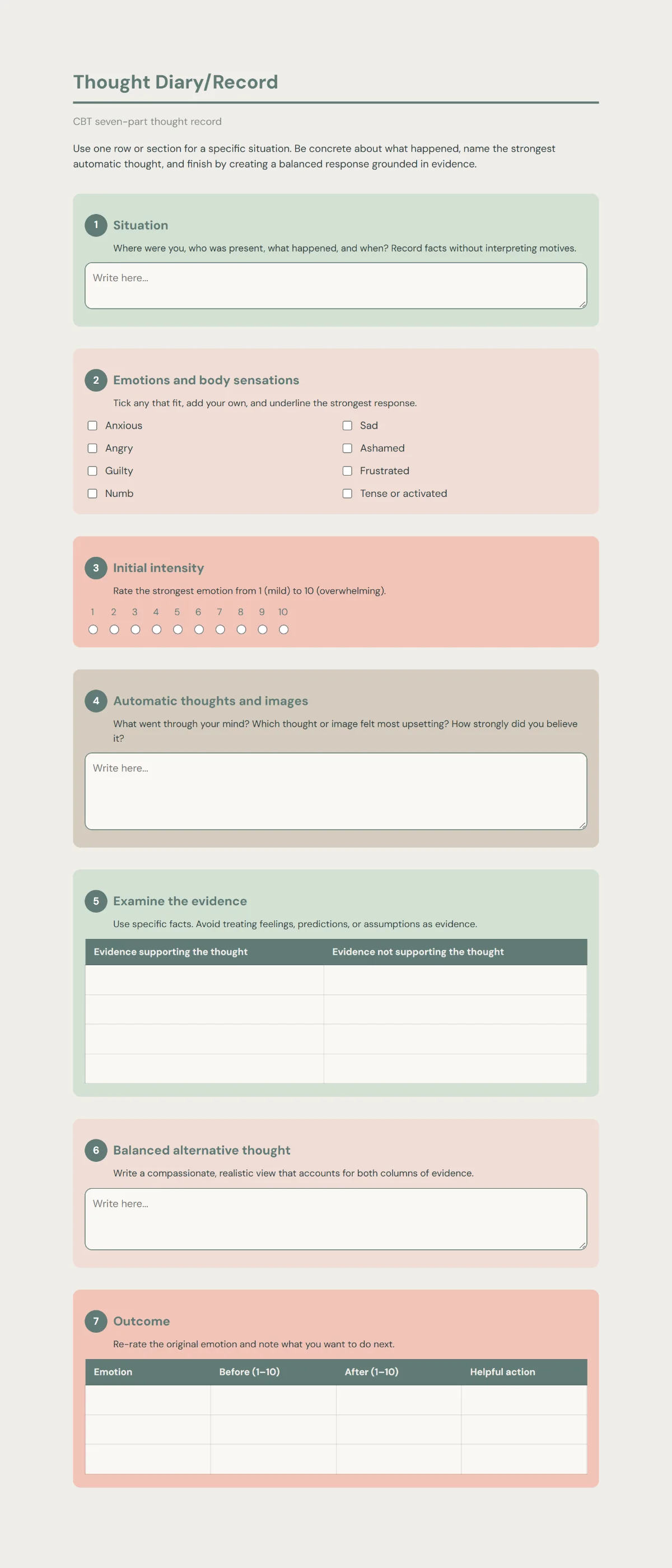
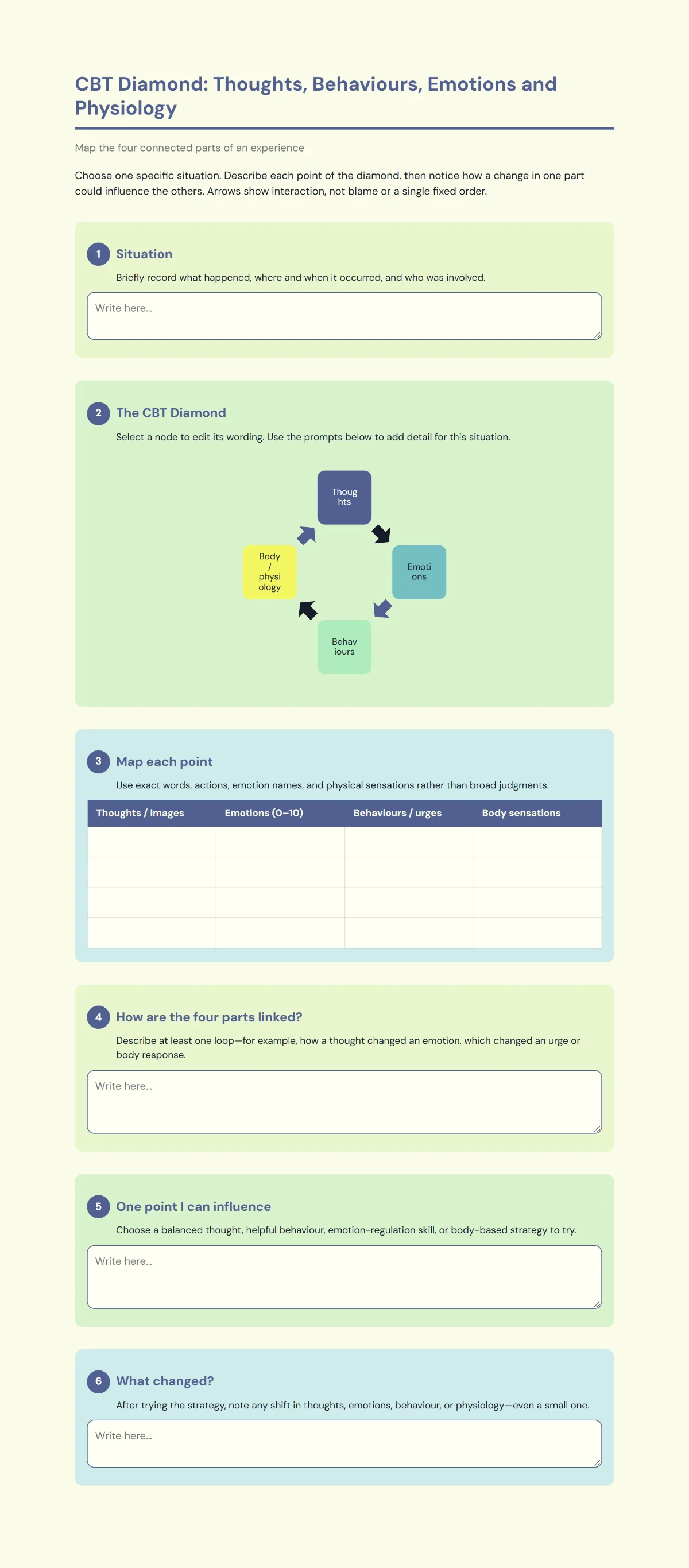
- Choose one specific, realistic response for tomorrow, such as pausing, naming the emotion, checking the facts, asking for support or doing something that matters to you. If one moment needs closer attention, a thought record worksheet or the CBT diamond worksheet can help you unpack it (Greenberger & Padesky, 2016).
Using emotion logs in therapy
Emotion and mood logs are often among the first homework tasks in CBT and DBT, because they provide real-world data for formulation and a baseline against which to track change (Korotitsch & Nelson-Gray, 1999; Greenberger & Padesky, 2016). Homework completion is associated with better outcomes in cognitive and behavioural therapy (Kazantzis et al., 2010).
The log also supports emotion-regulation work. Clients who can name emotions precisely have more options for regulating them (Kashdan et al., 2015), and the ‘my response’ column links naturally to skills such as checking the facts and opposite action in DBT (Linehan, 2015).
The worksheet is editable, so you can change the number of rows, swap in an emotion list that suits a particular client, or replace the final prompt with a specific skill you are practising together.
Does tracking emotions help?
Tracking has several research-backed benefits. Self-monitoring can change the behaviour being monitored, a known effect called reactivity (Korotitsch & Nelson-Gray, 1999). Putting feelings into words reduces emotional reactivity in the brain (Lieberman et al., 2007). And greater emotion differentiation is linked with better regulation and fewer unhelpful coping responses (Kashdan et al., 2015).
Writing about emotional experiences more generally has been associated with improvements in physical and mental health (Pennebaker, 1997). An emotion log is a structured, lighter version of that practice.
Things to keep in mind
Recording an experience can change it, which is usually part of the benefit (Korotitsch & Nelson-Gray, 1999). Some people find, though, that closely tracking emotions increases their focus on distress, especially at first. If logging leaves you feeling worse, shorten it, log less often or talk it through with a therapist. The aim is noticing, not dwelling.
An emotion log is not a diagnostic tool. If you notice persistent low mood, intense anxiety, or thoughts of harming yourself, speak with a GP, psychologist or other qualified professional.